Fabless semiconductor · Vancouver, BC
Silicon IP for elliptic-curve cryptography
Node Labs designs the point multipliers and signature-verification cores at the heart of modern cryptography — and proves them in real hardware before they ever reach an ASIC. Because the math that secures a blockchain should never be the reason it stays small.
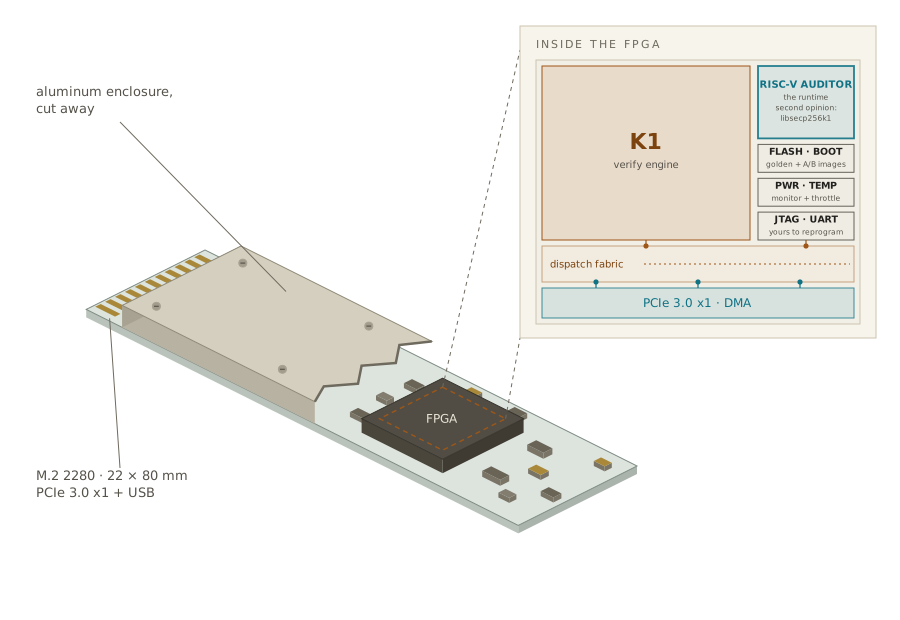
Generated from our repositories, commit-stamped — not marketing copy. See the full panel →
Why this exists
The bottleneck nobody solved
Every transaction a blockchain accepts rests on signature verification — the costliest step of validating a block. For fifteen years the ecosystem has worked around that cost rather than removing it. Removing it is what Node Labs does.
THE PROBLEM
Nodes already skip it
Checking every signature from genesis is expensive enough that Bitcoin Core skips historical blocks by default (assumevalid) — the ecosystem's most conservative software already treats full verification as too slow to insist on. With cheap verification, you check everything.
Why not just use a CPU? →THE CEILING
It's why blocks stay small
Purpose-built silicon made mining ∼600,000× more efficient in fifteen years. Validation never got that treatment — it stayed on general-purpose CPUs, and Bitcoin's capacity stayed where it was: roughly seven transactions per second. A chain can only scale as far as ordinary machines can afford to verify.
The mining-hardware precedent →THE ANSWER
Point silicon at verification
The same trajectory, aimed at the operation networks actually depend on: one M.2 card verifies 297,100 signatures per second — measured on real hardware, running live below. Enough that verification is never the reason to skip checks or keep blocks small.
The Blitz card →Live from the bench
A real card is running right now
The meter beside this text is not a mockup. It streams 20×/s from a real Ti375 FPGA on our bench in Vancouver, verifying Schnorr signatures as you read this — including checks mirrored from a live node on Nexa, the big-block chain we partner with to prove our silicon in production. If the bench is offline, it says so.
Most of the time the needle sits near idle — today's networks barely register against hardware like this. That headroom is the point: capacity has to exist before the traffic that needs it can, and validation should never again be the reason a chain stays small.
Push load onto it yourself →live — streamed from the bench in Vancouver. Open the full viewer
What we build
One engine. Two ways to get it.
Our business is licensable silicon IP for cryptographic acceleration. Our hardware exists to prove that IP on real workloads — and to put it in your machine.
K1 · Licensable IP
secp256k1 compute engine
The core that does the heavy elliptic-curve math, proven in real hardware — with the verification story published, not asserted. Licensed under NDA.
Blitz · Hardware
M.2 FPGA accelerator card
K1 cores in a spare M.2 slot — or any PCIe slot with a cheap adapter. Runs our encrypted bitstreams and any bitstream you build yourself.
Path to silicon
FPGA-proven today. ASIC next.
NOW
Field validation on FPGA
K1 verification cores running on Blitz hardware, exercised on real cryptographic workloads — including live testing on the Nexa network, where our founder is one of the network's designers.
NEXT
130 nm trial tape-out
A trial core through the open-source OpenROAD flow to de-risk the path to production silicon.
THEN
Advanced-node production run
The secp256k1 point multiplier core — working in hardware today — fabricated at a leading foundry.